Beyond the Wrench: The Marketing Systems Every Modern Plumber Needs
I spent three years managing Google Ads accounts for national brands before I started working with plumbers, and I’ll tell you what shocked me most: the smartest operators I know—guys who can diagnose a slab leak in twenty minutes—are running their marketing like it’s 2009.
Not because they’re lazy. Because every time they try something new, they get burned.
Last month a shop owner in Raleigh told me he spent $4,200 on Google Ads and got “nothing but tire-kickers.” When I pulled his account data, he’d generated forty-three form fills. The problem wasn’t the channel. It was that nobody called those leads back within four hours, his intake form asked for too much information, and his ad copy promised “affordable service”—code for “I’m shopping five plumbers for the lowest bid.”
And nobody’s tracking what actually puts a booked job on the calendar.
Why Most Plumbing Marketing Fails: It’s Not the Channel, It’s the Conversion Infrastructure
Here’s what I see when I audit a struggling plumbing firm’s lead flow: they’re pouring water into a bucket with three holes in the bottom, then blaming the faucet.
The Three Holes Killing Your Lead Flow
| Hole | What’s Broken | What It Costs You |
|---|---|---|
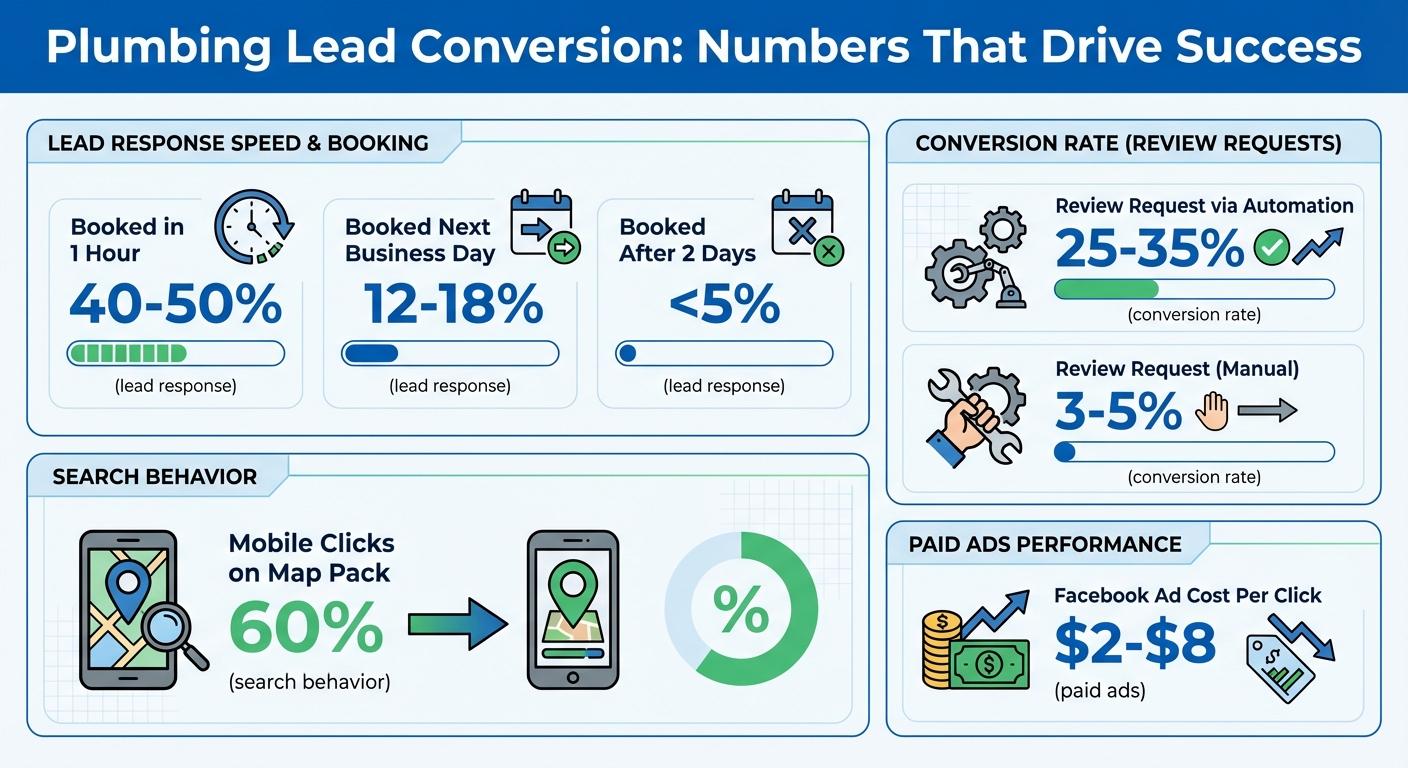
| Invisible Online Presence | Google Business Profile untouched for months, generic service listings, outdated photos | Lost to competitors in Map Pack searches—60% of mobile clicks you never see |
| Lead Response Black Hole | No automated confirmation, callbacks delayed by days, form submissions checked “when there’s time” | 40-50% booking rate drops to under 5% when response time exceeds 48 hours |
| Zero Post-Job Follow-Up | No review requests, no satisfaction checks, no maintenance reminders | Customer was happy but books with whoever markets to them next season |
Industry data shows the plumbing services sector generated 62 transactions in Q2 2024, a 72% increase year-over-year—meaning your competitors are getting faster and more aggressive while you’re letting leads go cold.
The shops that are winning right now—the ones booking thirty to fifty jobs a week in mid-sized markets—aren’t doing anything magical. They’ve just plugged those three holes with a system that runs whether the owner is on a job site or not.
The Local Intent Capture System: Google Business Profile as Your 24/7 Sales Rep
If you’re spending money on ads before your Google Business Profile is dialed in, you’re doing it backwards.
When someone searches “plumber near me” or “fix leaking toilet Greensboro,” Google shows the Map Pack—those three businesses at the top with the map pins. That placement is free and where 60% of mobile searchers click first.
But Google doesn’t just show whoever’s closest. It shows whoever has the most complete, active, recently updated profile with strong reviews and relevant photos.
What a Working GBP Looks Like
Business Description That Converts
Your business description should list specific services and your service area. Not “We’re a family plumbing business serving the community.” Instead: “Emergency drain clearing, water heater replacement, sewer line repair, and repiping in Durham, Chapel Hill, and Carrboro. 24/7 emergency service, licensed and insured since 2008.”
Service List Specificity
Your service list should have fifteen to twenty specific entries:
- Water heater repair
- Water heater replacement
- Toilet repair
- Toilet installation
- Drain cleaning
- Sewer camera inspection
- Leak detection
- Garbage disposal repair
- Faucet installation
Each one is a search term someone might use.
Photo Activity Signals
Post one photo per week minimum: a finished job, your truck at a job site, a before-and-after of a water heater swap. Phone photos work fine if they’re clear and show your work.
Review Velocity Wins
Review velocity separates the Map Pack winners from everyone else. If you have forty-three reviews from 2019-2022 and nothing recent, Google assumes you’re not active. Your competitor with thirty-eight reviews but six from the last month looks like the better bet.
Real Result: One shop I worked with in Wilmington went from position five or six to position two in the Map Pack within six weeks. We updated their GBP description, added twelve specific service listings, posted two photos per week, and implemented a post-job review request system that brought in nine new reviews. Their call volume from Maps searches doubled.
Paid Acquisition: When to Use Google Ads vs. Facebook Ads (and What to Measure)
Once your GBP is pulling its weight, paid traffic makes sense—but only if you know which channel solves which problem.
Google Ads work when someone is actively searching for a solution right now. They type “emergency plumber” or “water heater replacement cost” and your ad shows up. This is high-intent traffic. The cost per click is higher ($15-$45 in most markets), but the conversion rate is higher too.
Facebook Ads work when you want to build awareness or capture people before they have an emergency. You’re targeting homeowners in your service area with messaging like “Is your water heater over ten years old? Most fail between years 10-12.” The cost per click is lower ($2-$8), but the conversion rate is also lower because they’re not in crisis mode yet.
Channel Selection Framework
Scenario 1: Smaller Shop (1-3 Trucks) Needing Jobs This Week
Start with Google Ads focused on emergency and high-urgency terms. Set a daily budget you can afford to lose—$50-$75 to start—and track cost per booked job, not just cost per click. A $40 click that books a $850 water heater replacement is a win.
Scenario 2: Established Operation Building Pipeline
Add Facebook Ads targeting homeowners 35-65 in your service area with educational content. Use lead forms directly on Facebook and keep them short—name, phone, zip code, and “what service do you need?” Every extra field drops your conversion rate by 10-15%.
Scenario 3: Highly Competitive Market with Brutal CPC
Test Facebook first, but with a tighter geographic radius (three to five miles instead of fifteen) and very specific targeting: homeowners, household income over $75K, interested in home improvement.
The Conversion Infrastructure: Lead Capture, Booking, CRM, and Review Automation
This is where most plumbing firms lose the game. They get the lead. Then nothing happens fast enough.
Shops that call or text a new lead within one hour book 40-50% of them. The ones that wait until the next business day book 12-18%. If you wait two days, you’re under 5%. The lead has already called two other plumbers and booked with whoever answered first.
Lead Capture Forms: The Friction Audit
Keep them short. Name, phone, email, service needed, and optionally a brief description. That’s it. Every extra field is friction.
The intro text on the form matters. If your Google Ad says “Emergency drain clearing—available 24/7,” and your form says “Request a quote,” that’s a mismatch. The form should say “Get emergency drain clearing now—we’ll call you within 15 minutes.”
Booking Systems: Three Non-Negotiables
A basic booking system (ServiceTitan, Housecall Pro, Jobber—pick one that fits your size and budget) does three things that matter:
- Automated Confirmation
Sends an automated confirmation text or email immediately when someone books. “We’ve got you scheduled for Thursday at 2 PM. Here’s your tech’s name and photo.” That text cuts no-shows by 30-40%. - Source Attribution
Tracks where each lead came from. You’ll know if your Google Ads are generating booked jobs or just form fills. - Automatic Follow-Up Triggers
Makes follow-up automatic instead of dependent on someone remembering.
CRM Systems and Follow-Up Sequences
When a lead comes in and doesn’t book immediately, it goes into a follow-up sequence:
- Day 1: “Hi, this is Sarah from ABC Plumbing. I saw you requested info about water heater replacement. Do you have five minutes to discuss options?”
- Day 3: “Following up on your water heater question—we have availability this week if you’d like to get it handled before it fails completely.”
- Day 7: “Last check-in—if you’re still considering a replacement, I can get you a firm quote over the phone in ten minutes.”
Most leads don’t book on the first contact. If you’re the only one that follows up twice, you win by default.
Review Automation: The Easiest Win
After every completed job, your system should send a text within two hours: “Thanks for trusting us with your plumbing repair today. If we earned it, would you mind leaving a quick review? [link]”
Shops that do this get 25-35% of customers to leave a review. Shops that rely on the tech remembering to ask get 3-5%. Over six months, that’s the difference between forty new reviews and four.
For more comprehensive guidance on building these systems, plumber marketing services that integrate all these components can accelerate your timeline—but the principles above are what you’re paying for, and you can start testing them yourself this week.
The 30-Day Implementation Sequence
You don’t need to do all of this at once. Here’s the sequence I walk clients through:
| Week | Focus Area | Specific Actions | Success Metric |
|---|---|---|---|
| Week 1 | Google Business Profile | Update description, add 10+ service listings, post 3 photos, set weekly photo reminder | Profile completeness at 100% |
| Week 2 | Review Requests | Implement manual or automated review request within 2 hours of job completion | 25% review conversion rate |
| Week 3 | Lead Response Speed | Track response time for every lead, assign hourly form check responsibility | Under 1-hour response time |
| Week 4 | Paid Channel Test | Launch $50/day Google Ads OR $30/day Facebook Ads in tight service radius | Under $150 cost per booked job |
Your Next-Week Checklist
Here’s what you can do in the next seven days without hiring anyone or spending money on ads:
Monday
Log into your Google Business Profile. Update your business description to include specific services and your service area. Add ten specific service listings if you don’t have them already.
Tuesday
Post a photo of a recent job or your truck at a job site. Set a recurring reminder to do this every Tuesday.
Wednesday
Pull your lead data from the last thirty days. How many form fills or calls did you get? How many turned into booked jobs? What’s your conversion rate? If you don’t have this data, start tracking it today.
Thursday
Audit your lead response time. When the next lead comes in, note what time it arrived and what time someone called them back. If it’s over one hour, make this your top priority.
Friday
Send a review request text to your last five completed jobs. Use this exact script: “Hi [name], this is [your name] from [company]. Thanks for trusting us with your [service] yesterday. If we earned it, would you mind leaving a quick review? [link]”
The firms that are thriving right now aren’t doing anything you can’t do. They’ve just built a system that captures local intent, follows up fast, and turns happy customers into reviews and referrals.
The competition is getting fiercer—recent market analysis shows private equity firms have invested over $31 billion in home services acquisitions since 2014, meaning well-funded competitors are entering your market with sophisticated marketing systems already in place.
But here’s the thing: they’re optimizing for scale, not speed. A small shop that responds in fifteen minutes and shows up when promised will beat a private-equity-backed operation that takes four hours to return a call. You just need to build the system that makes that speed automatic instead of heroic.
Start with your Google Business Profile this week. Fix your follow-up next week. Test one paid channel the week after that. Small fixes, measured consistently, compound faster than you think.