
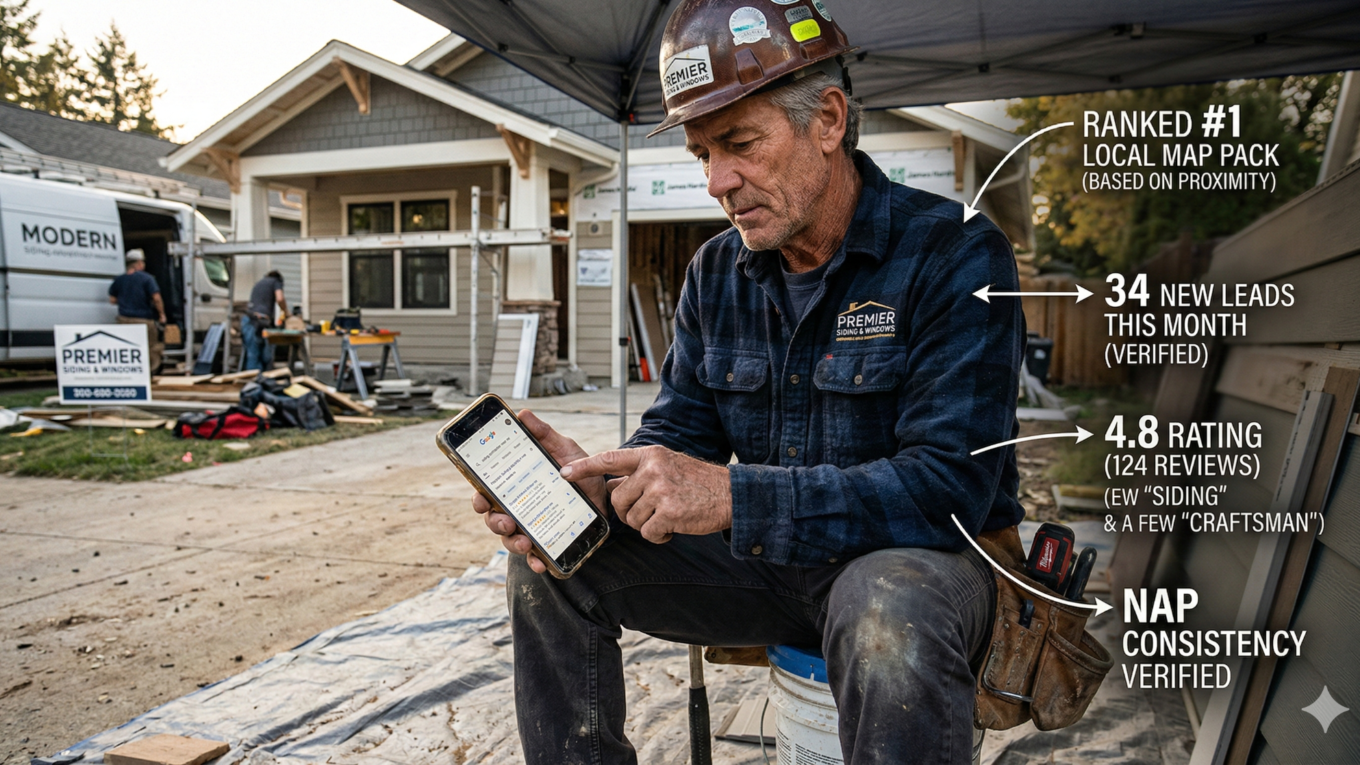
Hidden in Plain Sight? Why Your Siding Business Isn’t Showing Up on Google
I spent four years estimating exterior jobs before I ever touched a Google Business Profile. Back then, I thought visibility meant having a truck wrap and a yard sign at the jobsite.
Then I watched a contractor I respected—someone who’d been in business twenty years longer than me—close his doors because “the phone stopped ringing.” His work was flawless. His reputation in the neighborhood was solid. But when homeowners searched “siding contractor near me,” he didn’t exist.
That’s when I started auditing Google Business Profiles and local search setups for roofing, siding, and window contractors. What I found wasn’t a mystery. It was a pattern.
The “We’re Busy Online” Trap vs. Actually Getting Chosen
Most contractors fall into one of two camps.
The first group posts regularly on Facebook, maybe running a boosted post here and there, convinced they’re “doing digital marketing.” The second group bought an SEO package that generated traffic reports and keyword rankings but didn’t move the phone. Both are frustrated, asking the same question: “Why isn’t this working?”
Here’s what I see when I audit their setups: they’re visible in the wrong places or visible in the right places but not credible. A homeowner searching for exterior remodeling doesn’t care that you posted three times this week. They care whether you show up in the Google Maps pack when they type “replace siding [neighborhood name],” whether your profile looks legitimate, and whether other people vouch for your work.
If you’re running ads to a website that doesn’t show project photos, or your Google Business Profile lists the wrong service area, or your last review is from 2021, you’re not competing. You’re just spending money.
The Four Pillars That Determine Whether Homeowners Find You
When I walk a contractor through what’s broken, I start with the four pillars that determine whether a homeowner finds you, trusts you, and calls you.
Pillar One: Google Business Profile Optimization
This is your storefront in local search. If your profile is incomplete, miscategorized, or inconsistent with your website, Google doesn’t know how to rank you.
I’ve seen contractors lose Map pack visibility because they chose “General Contractor” as their primary category instead of “Siding Contractor” or “Roofing Contractor.” Google’s algorithm prioritizes specificity. When someone searches for siding work, it wants to show siding specialists, not generalists.
Your business name, address, and phone number—what the industry calls NAP consistency—must be identical everywhere:
- Your Google profile
- Your website footer
- Your Yelp listing
- Your citations on home improvement directories like Houzz, Angi, and HomeAdvisor
If your website says “123 Main Street” and your Google profile says “123 Main St.,” that’s a mismatch. It sounds trivial, but Google uses NAP data to verify legitimacy. Inconsistencies signal uncertainty, and uncertain businesses don’t rank.
Pillar Two: Local Search Foundations
This is the infrastructure that tells Google where you operate and what you do. Your website needs location-specific pages if you serve multiple towns or counties—not just a generic “Service Areas” list.
A roofing contractor I worked with in Virginia had one page that said “Serving Central Virginia.” When we built out individual pages for Charlottesville, Albemarle County, and Fluvanna County with project examples and neighborhood-specific details, his organic visibility doubled in six weeks.
Homeowners don’t search for “Central Virginia roofer.” They search for “roofer near me” or “roofer in [specific town].”
Pillar Three: Proof Assets
These are the trust signals that convert a search result into a phone call.
Your project gallery isn’t a nice-to-have; it’s a decision-making tool. Homeowners want to see before-and-after photos of jobs like theirs, in neighborhoods like theirs, with materials they’re considering. Organize galleries by project type (siding replacement, window installation, full exterior remodel) and include captions that explain the scope, materials, and timeline.
“James Hardie siding installation, Craftsman-style home, Charlottesville—completed in 8 days” is infinitely more useful than a photo dump with no context.
Customer testimonials work the same way. A written review that says “They showed up on time and cleaned up every day” is more persuasive than five generic five-star ratings with no text. According to industry trends, homeowners increasingly rely on detailed feedback to differentiate between contractors. The content of reviews—especially those with text—carries more weight in rankings than star ratings alone.
Pillar Four: Review Operations
This is the system that generates and manages online reviews consistently, not sporadically.
Most contractors ask for reviews only when they remember, which means their profile goes months without new feedback. That’s a red flag to both Google and homeowners. A steady flow of recent reviews signals that you’re active, reliable, and worth considering.
I recommend a simple follow-up sequence: send a thank-you text or email within 48 hours of project completion, include a direct link to your Google review page, and make it easy. “If you’re happy with the work, we’d appreciate a quick review here: [link].” That’s it.
Responding to reviews—positive and negative—also matters. It shows you’re engaged and professional. For negative reviews, respond quickly, acknowledge the concern, and offer to resolve it offline. For positive reviews, a short “Thank you, [name]—it was great working with you” is enough.
Setting Up Your Google Business Profile: The Complete Walkthrough
I’ve audited hundreds of Google Business Profiles, and the mistakes are almost always the same. Let me walk you through the setup that actually works.
| Step | Action | Why It Matters |
|---|---|---|
| 1 | Claim and verify your profile | Unverified profiles can’t be edited or optimized |
| 2 | Choose your primary category carefully | Single most important ranking factor in local search |
| 3 | Fill out every field | Google rewards complete profiles |
| 4 | Add high-quality, geotagged photos | Verifies you’re active in your service area |
| 5 | Enable messaging and Q&A | Shows you’re responsive and engaged |
| 6 | Post updates regularly | Keeps your profile active |
Claim and verify your profile. Go to google.com/business and search for your business name. If it exists but isn’t claimed, claim it. Google will send a postcard with a verification code to your business address. This takes 5-7 days.
Choose your primary category carefully. If you’re primarily a siding contractor, your primary category should be “Siding Contractor,” not “General Contractor.” You can add secondary categories (Roofing Contractor, Window Installation Service), but the primary category drives how Google matches you to search queries.
Fill out every field. Business description, hours, services, service area, website URL, phone number—complete all of it. In your business description (750 characters max), focus on what you do and where you do it: “Family-owned siding and roofing contractor serving Charlottesville and Albemarle County since 2008. Specializing in James Hardie siding, vinyl siding replacement, and full exterior remodels.” Be direct.
Add high-quality, geotagged photos. Upload at least 10-15 photos: exterior shots of your team at work, completed projects, your vehicles, your office if you have one. Geotagged images help Google verify that you’re active in your service area. Take new photos every month and upload them.
Enable messaging and Q&A. Turn on the messaging feature so homeowners can text you directly from your profile. Monitor the Q&A section—if someone asks a question publicly and you don’t answer, it looks like you’re not paying attention.
Post updates regularly. Google Posts don’t directly affect rankings, but they keep your profile active. Post about completed projects, seasonal services, or helpful tips. Once a week is plenty.
When Your Rankings Drop or Disappear: The Troubleshooting Checklist
I get panicked messages about this constantly: “We were in the top three on Google Maps, now we’re gone.”
It’s usually not a penalty or a Google update. It’s something simpler.
First, check your Google Business Profile for suspension or edits you didn’t make. Google sometimes flags profiles for policy violations (usually related to fake reviews or keyword-stuffed business names). Log in and look for warnings.
Second, verify your NAP consistency again. If you recently moved, changed your phone number, or updated your website, and those changes aren’t reflected everywhere, Google may have demoted you while it figures out which information is correct.
Third, check your competitors. If a new contractor opened nearby and optimized their profile aggressively, they may have displaced you in the Map pack. Local search is relative—your ranking depends on how you compare to others in your area.
Audit the top three listings:
- What categories are they using?
- How many reviews do they have?
- How recently were those reviews posted?
- What does their photo gallery look like?
The Review System That Builds Authority Without Feeling Pushy
Contractors hate asking for reviews. I get it. It feels awkward, especially when you’ve just spent two weeks at someone’s house.
But here’s the reality: homeowners expect to be asked, and most are willing to leave a review if you make it easy and timely.
The system I recommend is a three-touch sequence:
Touch one happens on the last day of the project, in person. “We really appreciate your business. If you’re happy with the work, we’d love a review on Google—it helps other homeowners find us.” Just plant the idea.
Touch two happens 24-48 hours later via text or email. “Hi [name], thanks again for trusting us with your siding project. If you have a moment, we’d appreciate a review here: [direct Google review link].” Keep it short.
Touch three is optional and happens a week later if they haven’t left a review. “Hi [name], just following up. If you’re happy with the work, a quick review would mean a lot. Here’s the link again: [link].” If they don’t respond after this, let it go.
For negative reviews—and you will get them eventually—respond within 24 hours. Acknowledge the issue, apologize if appropriate, and offer to resolve it offline. “We’re sorry to hear about your experience. We’d like to make this right. Please call us at [number] so we can discuss this further.”
Don’t argue publicly. It makes you look defensive, and future customers are watching how you handle conflict.
Paid Ads vs. Organic Visibility vs. Directory Listings: What Actually Pays Off
Contractors ask me all the time whether they should run Google Ads, invest in SEO, or pay for leads from Angi or HomeAdvisor.
The answer depends on where you are right now and what you’re trying to fix. With market growth expanding at a CAGR of 4.31% through 2035, the opportunity for contractors who get visibility right is significant.
When to Use Google Local Services Ads
If your phone isn’t ringing at all and you need jobs this month, Google Local Services Ads (the ones with the green “Google Guaranteed” badge) are the fastest path to visibility. You pay per lead, not per click, and Google vets your business before approving you.
The downside: you’re competing with every other contractor in your area who’s also running LSAs, and the cost per lead can be high depending on your market.
When to Invest in Organic SEO
If your Google Business Profile and website are optimized but you’re not ranking as high as you’d like, organic SEO is the long game. This means building out location-specific pages, earning backlinks from local sources, and consistently publishing helpful content.
For seo for siding contractors, the payoff is sustainable—once you rank, you don’t pay per click or per lead. But it takes 3-6 months to see meaningful movement.
The Reality of Directory Listings
Directory listings—Houzz, Angi, HomeAdvisor, Thumbtack—are a mixed bag. The free listings are worth claiming and keeping updated because they contribute to your overall citation profile and NAP consistency.
The paid lead-generation programs are expensive and often frustrating. You’re competing with multiple contractors for the same lead, and homeowners are usually price-shopping rather than looking for quality.
My Recommended Priority Order
Here’s my hierarchy for most small-to-medium exterior remodeling businesses:
- Fix your Google Business Profile first (free, high impact)
- Build out your website’s local pages and project gallery (low cost, sustainable)
- Consider Google Local Services Ads if you need immediate lead flow (pay-per-lead, fast results)
- Treat directory listings as supplementary, not primary
The Tools You Actually Need (and the Ones You Don’t)
You don’t need a $500/month software stack to manage local visibility. You need a handful of reliable, affordable tools that handle the repetitive tasks and give you the data you need to make decisions.
For Google Business Profile management: I use GBP Manager (free Chrome extension) or BrightLocal (paid, around $30/month for basic plans). Both let you monitor your profile for unauthorized edits, track review velocity, and post updates without logging into Google every time.
For citation and NAP consistency audits: Moz Local or BrightLocal’s citation tracker will scan the web for mentions of your business and flag inconsistencies.
For review requests: Most contractors use a simple text or email automation tool like Podium, Birdeye, or even Mailchimp. The goal is to send the follow-up message automatically 24 hours after project completion. If you’re not ready to pay for software, a calendar reminder and a saved text template works fine.
For local rank tracking: I like LocalFalcon (around $20/month). It shows you exactly where you rank in the Map pack across different neighborhoods in your service area.
What you don’t need: expensive all-in-one marketing platforms that promise to “do everything,” AI content writers that churn out generic blog posts, or link-building services that spam low-quality directories.
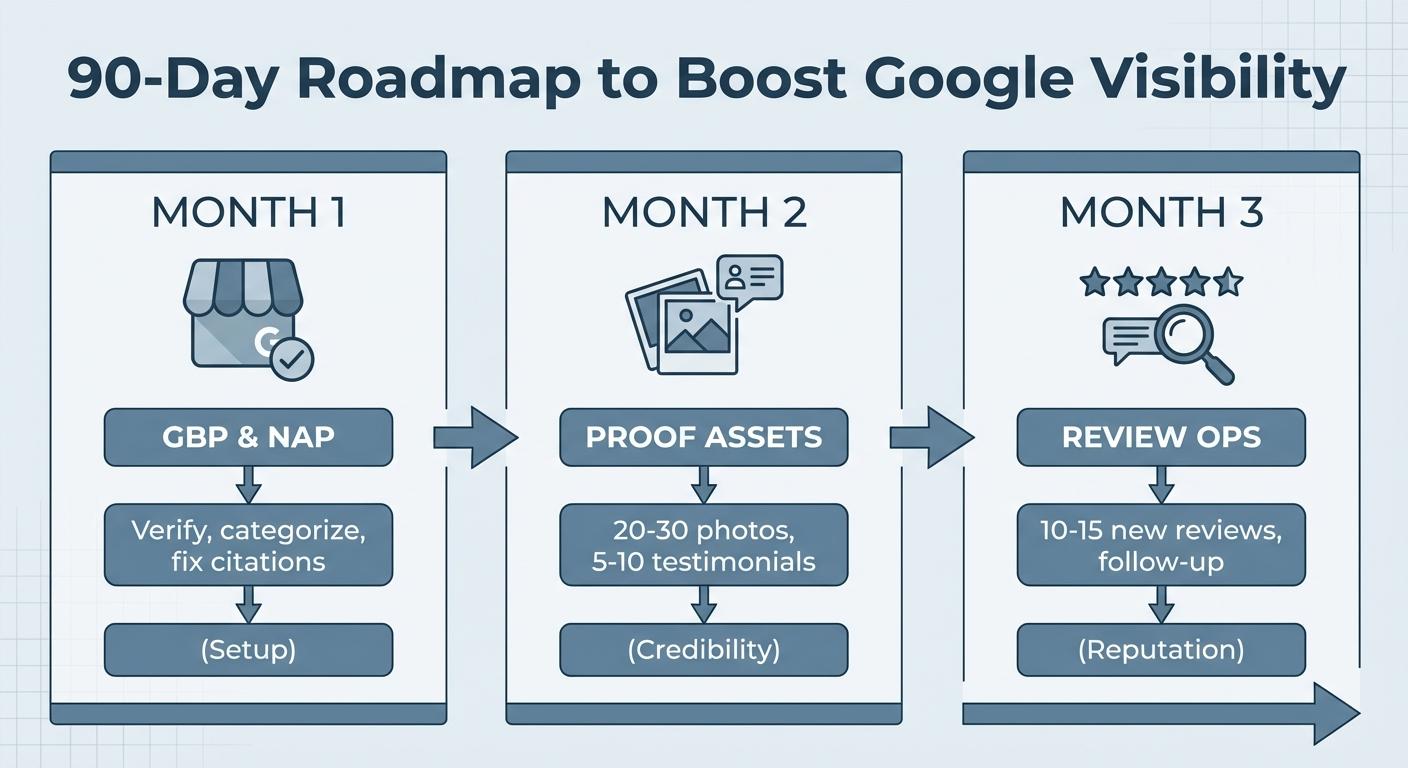
Your 90-Day Visibility Roadmap
Here’s what I tell contractors who want to fix their visibility before the spring/summer rush: focus on one pillar per month, execute it completely, then move to the next.
Month One: Google Business Profile and NAP Consistency
- Claim, verify, optimize categories
- Upload photos
- Audit and fix citation inconsistencies
Month Two: Proof Assets
- Build out your project gallery with 20-30 high-quality photos and captions
- Add 5-10 written customer testimonials to your website
- Create location-specific service pages if you don’t have them
Month Three: Review Operations
- Set up your follow-up sequence
- Ask for reviews on every completed project
- Respond to all existing reviews
- Aim for 10-15 new reviews by the end of the month
By day 90, you’ll have a complete, credible, active online presence that matches how homeowners actually search and decide.